Is Eco-Friendly Pest Control Safe for Kids and Pets?
It’s a fair question, and one we get a lot from Calgary families: if a product is strong enough to kill ants, wasps, or mice, is it really okay to have around a toddler who puts everything in his mouth, or a dog that licks the baseboards? “Eco-friendly” gets thrown around a lot in marketing, and it doesn’t always mean what people assume it means. So let’s actually break down what it involves, and where the real precautions still need to happen.
What “Eco-Friendly Pest Control” Actually Means
Eco-friendly doesn’t mean no products are ever used. It means the approach prioritizes reducing exposure and using the least amount of product necessary to solve the problem. In practice, that usually looks like:
- Identifying the pest and its entry points before applying anything
- Using sanitation and exclusion (sealing gaps, removing food sources) as the first line of defence
- Choosing targeted treatments, like gel bait placed in a specific spot, over broad spraying
- Reserving stronger products for situations where lower-impact methods genuinely aren’t enough
This general approach is often called Integrated Pest Management, or IPM. The Wikipedia overview of Integrated Pest Management describes it well: it’s less about avoiding pesticides entirely and more about combining multiple strategies so that chemical treatment is used carefully and only when it’s the right tool.
How IPM Actually Reduces Risk Around Kids and Pets
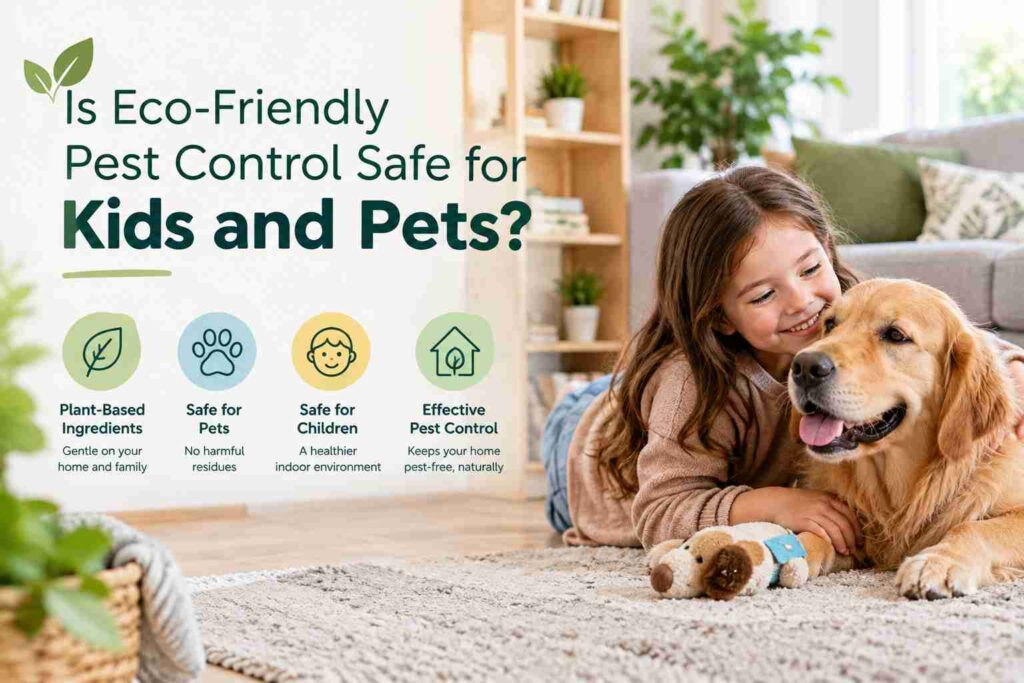
The safety benefit of an IPM approach isn’t that the products themselves are magically harmless. It’s that far less product ends up being used, and it’s placed in locations a curious toddler or a nosy dog isn’t likely to reach.
A few practical examples:
- Gel bait for ants placed inside a wall void or behind an appliance, not along an open baseboard
- Diatomaceous earth applied in wall voids or cracks rather than open floor space
- Sealing entry points so the pest doesn’t return, instead of repeat spraying
- Outdoor treatments timed and placed away from play areas, gardens, and pet-accessible zones
This is the same philosophy we use in our own work. Our recent post on how ant control works in Calgary homes covers this in more detail, but the short version is that sanitation and sealing usually do more of the work than any product does.
Lower-Risk Methods and Materials, at a Glance
| Method | How It’s Used | Why It’s Considered Lower-Risk |
|---|---|---|
| Diatomaceous earth | Applied in cracks, wall voids, and hidden areas | A mechanical, non-chemical substance; low toxicity, but still shouldn’t be inhaled directly |
| Gel baits | Placed in targeted spots away from open surfaces | Contained and localized rather than airborne or surface-sprayed |
| Sealing and exclusion | Physically closing entry points | No product involved at all; addresses the cause, not just the symptom |
| Humane trapping | Used for mice and other rodents | Avoids the disposal and secondary-exposure concerns of poison-based methods |
| Monitoring | Ongoing inspection instead of routine spraying | Reduces how often any product needs to be applied |
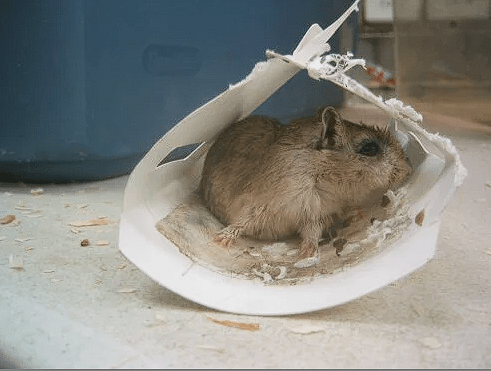
We’ve also written specifically about why we avoid certain conventional methods like glue traps for mice. Our post on humane solutions for mice explains both the welfare concern and why humane trapping tends to be a better fit for homes with curious pets.
Precautions Still Worth Taking, Even With Eco-Friendly Products
This is the part that’s easy to skip past. “Eco-friendly” doesn’t mean “no precautions needed.” Even the lowest-impact products deserve some basic care:
- Keep kids and pets out of a treated area until it’s had time to settle or dry, even for lower-risk products
- Store any leftover material well out of reach, not just closed but genuinely inaccessible
- Ask specifically where bait or treatment has been placed so you know what to keep an eye on
- Don’t assume “natural” automatically means “harmless in any quantity,” especially for pets that might chew or dig at treated soil
- Follow any specific guidance given by the technician for your particular home and pets
All pesticides sold and used in Canada, including lower-impact ones, are regulated by Health Canada’s Pest Management Regulatory Agency, which reviews products for safety before they’re approved for use. You can read more about how Health Canada regulates pesticides if you want to understand the approval process behind what’s used in your home.
Eco-Friendly vs. Conventional: What Actually Changes
| Factor | Conventional Approach | Eco-Friendly (IPM) Approach |
|---|---|---|
| Primary method | Broad spraying, scheduled regardless of activity | Inspection-led, treatment only where needed |
| Product placement | Often surface-level, more exposed | Targeted, usually in voids, cracks, or bait stations |
| Frequency | Routine, calendar-based | As-needed, based on monitoring |
| Focus | Killing visible pests | Addressing entry points and conditions, not just symptoms |
| Exposure risk to kids/pets | Higher, due to broader application | Lower, but not zero; precautions still matter |
Neither approach eliminates risk entirely, and that’s an honest thing to say. The difference is how much exposure is realistically possible and how much control you have over where products end up.
Questions Worth Asking Your Pest Control Provider
Before any treatment happens in a home with kids or pets, it’s reasonable to ask:
- Where exactly will products be applied, and are those areas accessible to my kids or pets?
- How long should we stay out of the treated area?
- Is there a lower-impact option for this particular pest?
- What should I watch for if my pet seems to have had contact with a treated area?
- Will this require repeat applications, or is it a one-time treatment?
A pest control provider who’s genuinely using an IPM approach should be able to answer all of these clearly and specifically, not just say “it’s all natural, don’t worry about it.”
Key Takeaways
- Eco-friendly pest control isn’t about avoiding products entirely; it’s about using targeted, minimal treatment and prioritizing sealing and sanitation first.
- Placement matters as much as the product itself. Gel bait in a wall void is a very different exposure risk than an open spray.
- All pesticides used in Canada, including lower-impact ones, go through Health Canada’s approval process.
- Basic precautions, like keeping pets and kids out of a treated area until it settles, still matter regardless of how low-impact the method is.
- Asking specific questions about placement and duration is a reasonable and useful thing to do before any treatment.
Summary
- Eco-friendly pest control, done properly, does reduce the risk to kids and pets compared to broad, routine spraying, mainly because far less product is used and it’s placed somewhere out of reach. It doesn’t mean zero precautions are needed. The safest approach is asking your provider exactly where treatment is happening, following any wait-time guidance, and understanding that “natural” or “low-impact” still means “handle it thoughtfully,” not “ignore it completely.”
Frequently Asked Questions (FAQs)
Does eco-friendly pest control mean no chemicals are used at all?
Not necessarily. It means chemical products are used more selectively and in lower amounts, with sealing, sanitation, and monitoring doing most of the work first.
Is diatomaceous earth safe around pets?
It’s considered low-toxicity and is commonly used in wall voids and cracks, but it shouldn’t be inhaled directly by pets or people, so placement matters.
How long should I keep my kids or pets out of a treated area?
This depends on the specific product and method used. Always ask your technician directly, since wait times can vary even among lower-impact treatments.
Are gel baits safe if my dog might find them?
Gel baits are typically placed in targeted, hard-to-reach spots specifically to avoid pet or child contact. Ask your technician exactly where bait has been placed so you can keep an eye on that area.
Why does Grove use an Integrated Pest Management approach?
It generally means less product used overall, treatment focused on the actual cause of the problem, and lower exposure risk for households with kids and pets. You can read more about our approach on our About page or get in touch to ask about eco-friendly options for your specific situation.