Why Routine Spider Control Matters for Commercial Buildings in Calgary
Walk into most commercial buildings in Calgary and you’ll find at least one cobweb tucked into a corner near the entrance, a cluster of webs along a loading dock ceiling, or a few cellar spiders hanging out in the server room. Most building managers either don’t notice or decide it’s not worth dealing with until someone complains. That’s understandable; there are bigger things to manage. But it’s also the wrong call, and it tends to catch up with you.
Routine spider control isn’t about keeping a pristine building free of every arachnid on the planet. It’s about understanding what spider activity tells you, what it signals to your clients and staff, and why a consistent approach is always less disruptive and less expensive than waiting for a problem to demand your attention. For Calgary commercial buildings, where foot traffic, seasonal pest pressure, and professional image all intersect, this is worth taking seriously.
The Spider Situation in Calgary: What You’re Actually Dealing With
Calgary has dozens of spider species, though only a handful are likely to end up inside your commercial building regularly. The most common are house spiders and cellar spiders, which are largely harmless and tend to build webs in corners, storage areas, and anywhere that doesn’t see much foot traffic or cleaning attention. Wolf spiders are also common; they don’t build webs but hunt actively on the ground, which makes them more visually alarming to anyone who encounters one crossing a warehouse floor or washroom.
Then there’s the western black widow. Alberta is one of the provinces where this spider does appear, primarily in southern regions and drier habitats, and while it tends to prefer undisturbed outdoor spaces like woodpiles and rock crevices, it’s not unheard of for them to turn up in storage rooms, garages, or spaces connected to loading docks. The western black widow is the only spider in Alberta classified as medically significant; its venom affects the nervous system and requires medical attention, particularly for children and older adults. The risk of a bite is genuinely low, but the possibility alone warrants more than a casual attitude toward spider management in commercial spaces.
Hobo spiders and cellar spiders round out the usual cast. Calgary’s winters push all of these species to seek warmth indoors earlier in the fall, and buildings with poor sealing, dense vegetation at the perimeter, or frequent deliveries give them plenty of ways in.
Spiders Are a Symptom, Not Just a Problem
This is the part most people miss. Spiders don’t randomly decide to move into your building. They go where the food is, and their food is other insects, flies, moths, ants, silverfish, and whatever else is sustaining a population inside or immediately outside your building.
When spider numbers are climbing, it’s almost always a sign that something else is going on. A loading dock that attracts flies. A kitchen area with a moisture problem is drawing in ants. Exterior lighting that pulls moths in at night, which then pulls the spiders that follow them. The spider activity you see is the downstream symptom of an insect population your building is unknowingly supporting.
This matters practically because treating spiders in isolation, just knocking down webs and spraying visible areas, doesn’t resolve the root issue. New spiders move in to take advantage of the same food source. Routine spider control done properly includes an assessment of what’s attracting them, not just what’s visible.
What Spiders Actually Cost a Commercial Building in Calgary
The easy answer is “not that much”, and if you’re measuring only the cost of a one-off web removal, you’re right. But that’s not the full picture.
Think about what a client sees when they walk into your lobby and clock a web in the corner near the reception desk. Or what a patient notices in a dental waiting room when a spider drops from the ceiling tile. Or what a food safety inspector documents when they find active webbing near storage in a commercial kitchen. First impressions are hard to undo, and in Calgary’s competitive business environment, the appearance of a poorly maintained facility, even for a reason as simple as an untreated spider issue, has real consequences.
For staff, arachnophobia is more common than most people acknowledge. It’s one of the most prevalent specific phobias, and employees who regularly encounter spiders in their workspace will say something — sometimes formally. Ongoing spider activity in an office or healthcare setting creates a low-grade discomfort that nobody talks about openly, but everyone feels.
Then there’s the physical mess. Webbing accumulates quickly in high-ceilinged warehouses, plant areas, and storage rooms. Removing it manually is repetitive maintenance work that adds up over time.
Which Calgary Commercial Properties Are Most at Risk
Not every commercial building carries the same level of spider pressure, but some property types are reliably more vulnerable.
Warehouses and distribution centres top the list. High ceilings, dark corners, constant delivery traffic, and gaps at loading docks create ideal conditions. These spaces are also harder to clean thoroughly, which means spider populations can establish and grow without being noticed for weeks.
Healthcare and dental clinics face a different kind of risk, it’s less about infestation volume and more about perception. A single spider encounter in a clinical setting erodes patient confidence in a way that takes time to rebuild.
Retail and hospitality businesses need to think about what happens when a customer spots a spider near product displays or in a restaurant corner. That experience goes straight to Google Reviews.
Office buildings with floor-to-ceiling glazing, green space nearby, or mature trees against the exterior tend to deal with higher spider ingress in fall, when temperatures drop, and spiders seek warmth. Buildings that were sealed tightly when they were new often develop gaps over time that go unnoticed until pests start using them.
Why “One-Off” Treatments Don’t Hold Up in Commercial Settings
Spider populations in Calgary operate on a seasonal rhythm. Late summer and early fall is peak activity, spiders are maturing, mating, and dispersing, which is exactly when building managers start getting complaints. A single treatment at that point provides relief, but it doesn’t account for the population still building up outside the perimeter, or the entry points that haven’t been addressed.
Without a follow-up treatment schedule and some attention to how spiders are getting in, the same building tends to be in the same position twelve months later. The one-off callout model ends up costing more over several years than a consistent maintenance program would, and it produces worse outcomes between visits.
Commercial buildings also cycle through more human traffic than homes, which means more opportunities for spiders to hitch rides in on deliveries, equipment, or personal items. That background pressure doesn’t stop between treatments.
How Grove Eco-Friendly Pest Control Approaches Spider Control in Commercial Buildings
Grove Eco-Friendly Pest Control works with Calgary commercial properties on spider control programs that are designed to actually hold up over time, not just knock back what’s visible right now.
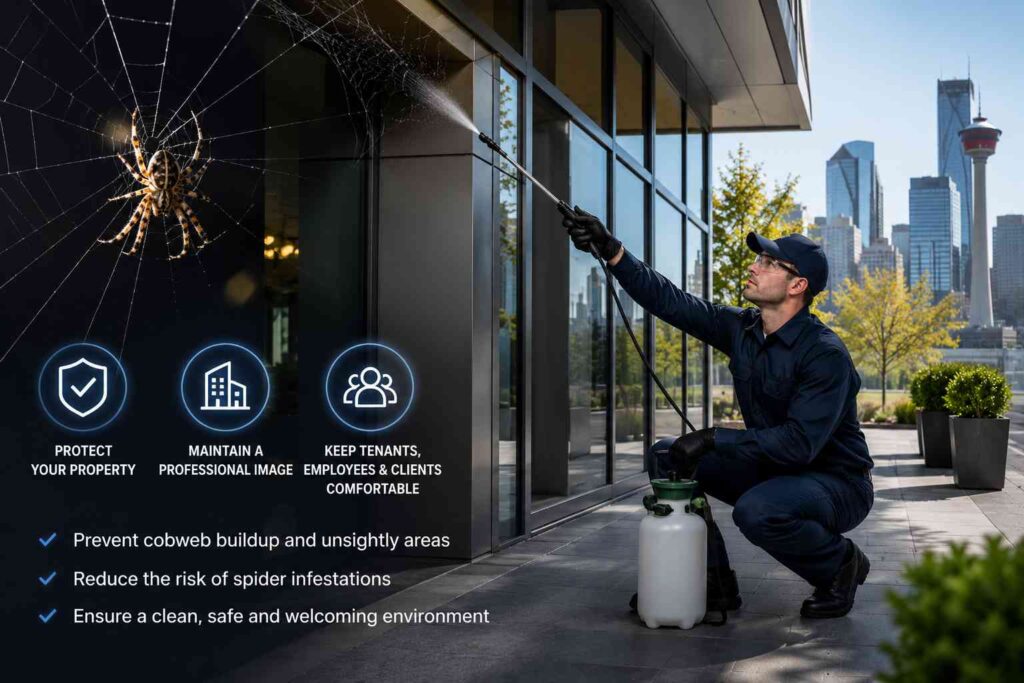
The approach starts with the perimeter. Treating the exterior of a building, including eaves, window frames, entry points, and any structural gaps, is where most of the leverage is. Getting ahead of spider ingress before they establish indoors is always easier than treating an active interior population. Web removal is included, and entry point assessment helps identify where ongoing attention is needed.
For the interior, Grove’s eco-friendly methods mean treatments that are safe for the people who spend their days in the building, healthcare patients, office staff, and retail customers. No harsh chemical residue, no extended wait times before re-entry, no risk to sensitive individuals. That’s not a marketing claim; it’s what differentiates properly designed eco-friendly pest control from conventional approaches that rely on heavy chemical application.
Grove also offers ongoing commercial pest management plans for Calgary businesses that want the peace of mind of scheduled visits, proactive monitoring, and a consistent point of contact who knows their building. For property managers juggling a long list of responsibilities, that’s genuinely useful.
To arrange a commercial spider inspection or learn about ongoing programs, contact Grove Eco-Friendly Pest Control at (403) 902-2263 or visit grovepestcontrol.ca. Getting on a routine program before spider season peaks is always the smarter move.
Conclusion
Spiders in a Calgary commercial building aren’t a crisis until they are. The businesses that handle this well aren’t the ones that react fastest when things get bad. They’re the ones who set up a routine, understand what spider activity is telling them about their broader pest environment, and work with a pest control provider they trust to keep things consistently under control.
That’s exactly what Grove Eco-Friendly Pest Control offers. Practical, eco-conscious spider control for commercial properties in Calgary, built around your building, your staff, and your clients.
Frequently Asked Questions (FAQs)
Are spiders in Calgary commercial buildings actually dangerous, or just a nuisance?
The honest answer is: mostly a nuisance, but not entirely without risk. The majority of spiders you’ll encounter in a Calgary office, warehouse, or retail space are harmless species like house spiders and cellar spiders. That said, the western black widow does appear in Alberta, and while bites are rare, its venom is medically significant enough that you don’t want to be casual about it in a space where staff and clients are present. Even the harmless species cause real problems in terms of perception, staff discomfort, and professional image. Routine control addresses all of it.
How often should a commercial property in Calgary schedule spider treatments?
For most commercial buildings, a treatment schedule aligned with seasonal pressure works well, typically a perimeter treatment going into spring and again in late summer before fall activity peaks, with additional interior attention as needed. High-risk properties like warehouses, food service operations, or healthcare facilities may benefit from more frequent visits. Grove can assess your specific building and recommend a program that fits your operations.
We’ve tried spray treatments before and the spiders come back quickly. Why?
This is the most common frustration with one-off spider treatments, and it comes down to two things: entry points and food source. If gaps in the building’s exterior aren’t addressed and the insect population that’s attracting the spiders isn’t managed, new spiders will move in to fill the same niche within weeks. Effective spider control in a commercial building requires a broader view than just treating what’s currently visible. That’s why Grove’s approach includes perimeter assessment and root cause evaluation alongside the treatment itself.
Is eco-friendly spider treatment as effective as conventional chemical treatment?
Yes, when it’s done properly by trained, licensed technicians. Eco-friendly doesn’t mean weaker; it means targeted. The goal is to use methods that are specific to the pest and the environment, rather than blanketing a space with broad-spectrum chemicals that create their own risks. Grove’s methods are effective at reducing spider populations while being safe for the staff and clients who use your building every day.
We only have a few spiders right now. Do we really need professional control, or can we handle it ourselves?
A few spiders isn’t an emergency, but it’s worth thinking about what “a few” usually means in a commercial building. Spiders stay hidden, what you see is rarely the full picture. More importantly, even a modest spider presence usually indicates an underlying insect activity that will continue to attract more. Addressing it early, before it becomes a visible problem for clients and staff, is always easier and less disruptive than managing it after complaints have started. A professional inspection is a low-cost way to get an accurate read on what you’re dealing with.