Bird Removal in Calgary: Signs Birds Are Damaging Your Property
Most people don’t think of birds as a pest problem. They’re birds. They sing, they fly around, they sit on the fence. It takes a while before the average homeowner starts connecting the dots between that persistent chirping above the bedroom and the water stain spreading across the ceiling. By then, there’s usually a nest, some damage, and a repair bill waiting on the other side of it.
This happens a lot in Calgary. More than people realize, actually. The city’s blend of older residential neighbourhoods, flat-roofed commercial buildings, and cold winters creates a pretty ideal situation for birds looking for somewhere safe to settle — and once they find a spot they like, they don’t give it up easily. If you’ve had a nagging feeling that the birds around your property are doing more than just visiting, here are the signs that tell you you’re right.
Calgary’s Bird Problem Is Bigger Than Most People Think
Pigeons, European starlings, and house sparrows. Those three species are behind the overwhelming majority of bird damage complaints in Calgary, and they share one key trait: they’ve gotten very good at living in and around human structures. They’re not shy. They’re not going to move on just because you’d prefer they did.
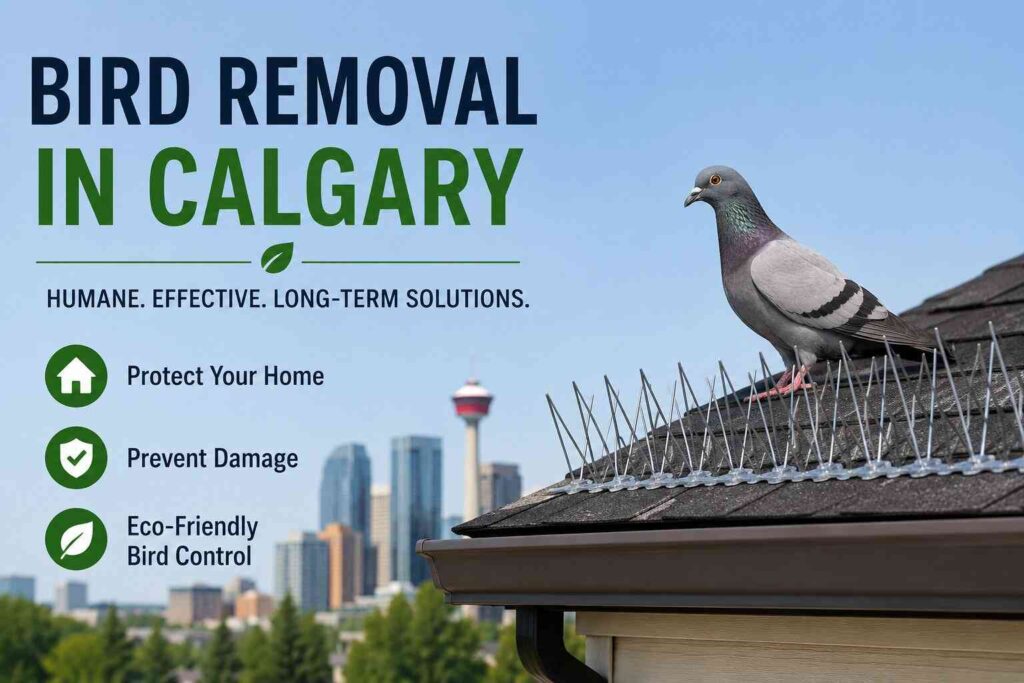
Starlings can squeeze through a gap the size of a toonie. Sparrows will nest inside a dryer vent without much hesitation. Pigeons will occupy the same ledge or rooftop corner for years, returning season after season, bringing others with them over time. One pair nesting on a property in spring can mean a much larger problem by the following year — and that’s not an exaggeration, it’s just how quickly things escalate when the root issue isn’t addressed.
Sign #1: Strange Sounds Coming From Your Roof or Walls
Scratching. Fluttering. A faint but persistent chirping that seems to be coming from inside the wall rather than outside it. If any of that sounds familiar, there’s a decent chance a bird has found its way into your eaves, soffit, or attic space.
Common entry points include damaged soffit panels, open roof vents, gaps where fascia meets the roofline, and any spot where flashing has started to pull away from the surface beneath it. Birds don’t need a large opening, they just need one. Once inside, they’ll build a nest and settle in for the season. The noise tends to peak in early morning, but if you’re hearing it daily and consistently from the same area, that’s a sign that needs attention sooner rather than later.
Sign #2: Bird Droppings Are Piling Up in the Same Spots
The thing about bird droppings that most people don’t fully appreciate is how corrosive they are. It’s not just unsightly, the uric acid in droppings actively eats into roofing materials, corrodes metal flashing, strips paint from vehicles, and breaks down concrete and wood over time. A concentrated roosting spot on one section of roof or ledge can cause measurable material damage within a single season.
There’s also a health concern that often gets glossed over in casual conversation. Dried droppings can carry pathogens, Histoplasma, which causes a lung infection called histoplasmosis, is one of the more serious ones. Salmonella is another. If droppings are accumulating near HVAC intakes, ventilation systems, or anywhere close to your home’s entry points, that’s not something to leave sitting.
Sign #3: You’ve Found a Nest Somewhere It Shouldn’t Be
Gutters are one of the most common nesting spots, and also one of the most damaging. A nest sitting inside a gutter section blocks drainage, which means water backs up and sits against your roofline, exactly where you don’t want standing water. Over time, that leads to rot, moisture intrusion, and in some cases mold getting into attic spaces.
Nests built near electrical components are a fire risk. The dry, fibrous materials birds use, twigs, grass, feathers, bits of insulation they’ve pulled from somewhere, are flammable, and when they’re sitting against something that generates heat, the risk is real.
One thing worth knowing before you climb up there and pull it out yourself: some bird species in Canada are protected under federal legislation, and disturbing an active nest can carry legal consequences. Professional bird nest removal in Calgary is handled with that in mind, the nest is dealt with properly, the entry point gets sealed, and you’re not left in a situation where it just gets rebuilt in the same spot a few weeks later.
Sign #4: Your Roof or Gutters Look Like Something Got Into Them
Birds, particularly pigeons and starlings, will physically work at a structure to get into it. They’ll pry at loose shingles, push apart soffit panels, and keep picking at any weak point until something gives. If you’re looking at your roofline and noticing displaced shingles, widened gaps around eave returns, or soffit sections that look like they’ve been nudged out of position, birds are a very plausible explanation.
Gutter damage is often more subtle but just as costly in the long run. Debris from nesting materials builds up, drainage gets restricted, and water starts going places it shouldn’t, against the foundation, behind the fascia, into wall cavities. The longer that sits, the more expensive the fix.
Sign #5: You’re Suddenly Dealing With Bugs Inside the House
This one takes most homeowners completely by surprise, and it’s worth knowing about. Birds carry ectoparasites, mites, lice, the occasional tick, into the spaces where they nest. When a nest is abandoned at the end of the season, those parasites don’t go with the birds. They stay put, and when the food source they relied on disappears, they migrate in search of a new one. Often that means moving further into the building.
If you’ve been dealing with small biting insects near attic access points or upper-floor bedrooms, and you’ve also had bird activity on your roof, it’s almost certainly connected. Treating the bugs without removing the birds and cleaning the affected area is just treating symptoms. The source has to go first.
What Professional Bird Control in Calgary Actually Involves
Plastic owls don’t work. Reflective tape works briefly, then stops working. Birds are smarter and more adaptable than most deterrent products give them credit for. For any established nesting or roosting situation, the only approach that actually holds up is one that combines proper exclusion, physically blocking every entry point, with deterrents appropriate for the specific species, followed by cleanup of contaminated areas.
That’s what professional bird control in Calgary looks like when it’s done right. An inspection that identifies not just the obvious entry points but the less obvious ones. Exclusion work that closes off access in a way that’s durable. And sanitation of the affected areas, because leaving droppings and nesting debris in place creates ongoing health and material risks even after the birds are gone.
Why Grove Eco-Friendly Pest Control
Grove Eco-Friendly Pest Control works with Calgary homeowners and businesses who want a bird problem solved properly, not temporarily patched. The approach is humane, eco-conscious, and built around lasting results rather than quick fixes that need to be repeated every spring.
Whether it’s a single nest in a gutter or pigeons that have been setting up shop on a commercial rooftop for years, Grove brings the local knowledge and the right methods to handle it. If any of the signs in this article are showing up around your property, now is the right time to get an assessment, before the next season makes the problem harder to deal with.
Contact Grove Eco-Friendly Pest Control and protect your property before the damage gets ahead of you.
Conclusion
Bird damage doesn’t announce itself. It builds, quietly, behind walls, inside gutters, under shingles, until the signs become impossible to ignore. Unusual sounds, droppings accumulating in the same spots, a nest somewhere it has no business being, visible roof damage, and unexpected insects indoors. Each of those on its own is a reason to look into it. All of them together means it’s time to call someone.
Grove Eco-Friendly Pest Control handles bird removal in Calgary with the kind of thoroughness that actually solves the problem. Reach out today, and don’t let another nesting season add to the damage already done.
Frequently Asked Questions (FAQs)
Is it legal to remove a bird nest in Calgary on my own?
It depends on the species and whether the nest is active. Canada’s Migratory Birds Convention Act protects a wide range of bird species, which means disturbing or destroying an active nest without proper authorization can result in real legal consequences. Before removing anything yourself, it’s worth getting a professional opinion. A licensed pest control company that handles bird nest removal in Calgary will know exactly what’s protected, what isn’t, and how to proceed without putting you in a difficult spot legally.
When is the best time of year to deal with a bird problem in Calgary?
Late fall through early spring is generally the safest window, nesting season is over, and birds haven’t begun establishing new nests yet. That said, if a nest or roosting spot is causing active damage or a health concern, waiting until the off-season isn’t always practical. In those cases, a professional can assess the situation and determine what can legally and safely be done right now.
What’s the difference between birds roosting on my property and birds nesting inside it?
Roosting is when birds use a surface, a ledge, rooftop, or eave, as a resting or sleeping spot. It’s a nuisance and causes droppings damage, but it’s an exterior problem. Nesting is when birds have actually gotten inside your structure, into an attic space, through a vent, behind a soffit panel, and built a nest there. Nesting tends to cause significantly more damage and is harder to resolve without professional exclusion work.
Are the methods Grove uses safe around kids and pets?
Yes. Grove Eco-Friendly Pest Control’s approach to bird control focuses on exclusion and physical deterrents rather than chemical treatments. The goal is to block access and make the space unsuitable for roosting or nesting, not to use products that could create exposure risks for your household. It’s one of the reasons their eco-friendly positioning isn’t just marketing language; it reflects how they actually work.
How fast can bird droppings actually damage a roof?
Faster than most people expect. In a concentrated roosting spot, the uric acid in droppings starts breaking down roofing materials and metal surfaces within months. Wooden fascia and eave components can show visible deterioration within a single season of heavy roosting. On flat commercial rooftops with membrane roofing, the damage can be especially severe. The longer it’s left, the more of the material is compromised, and at that point you’re looking at replacement rather than cleaning.