White Paper: How Deep Do Vole Tunnels Go? Understanding Burrowing Behavior in Calgary Soil
Premise
This white paper examines a single, clearly defined research question: how deep do vole tunnels go, and how does vole burrowing behavior interact with Calgary’s residential soil conditions, including lawns, gardens, and landscaped urban yards. This question matters now because vole damage in Calgary is consistently underestimated and misdiagnosed. In most residential cases, homeowners and property managers focus on visible surface runways while failing to understand where voles actually nest, feed, and overwinter. As a result, vole pest control efforts frequently target the wrong soil depth, leading to repeated infestations, wasted treatments, and escalating lawn and landscape damage.
In Calgary’s urban environment, vole activity is strongly shaped by compacted soils, engineered turf, and long winter snow cover. Understanding tunnel depth is therefore essential for accurate identification of voles in lawns versus other burrowing rodents, effective placement of traps or baits, and the design of physical barriers that intercept voles within their true activity zone.
Scope and Methodology
This research focuses exclusively on urban and suburban residential properties within Calgary, Alberta, including detached homes, townhouses, landscaped commercial properties, and managed green spaces. Comparative references were drawn from peer-reviewed and extension-based research conducted in the Canadian Prairie provinces and the northern United States, where soil composition and cold-climate conditions closely resemble those found in Calgary. The time range for reviewed material spans from 1990 to 2025, capturing both foundational vole ecology studies and more recent urban pest management documentation.
The research examined documented measurements of vole burrow and nest depths, seasonal tunneling behavior, and the influence of soil type, including clay-heavy subsoils, loam layers, and compacted urban fill commonly found beneath Calgary lawns. Particular attention was paid to how these factors affect vole control outcomes in residential settings.
Excluded from this analysis were speculative or anecdotal claims regarding vole burrow depth that lacked measurement or institutional backing. Non-vole rodents such as pocket gophers and ground squirrels were intentionally excluded to prevent conflation of burrowing behaviors. Marketing claims unsupported by primary research, university extension publications, or government documentation were also excluded.
Source material consisted of Canadian and U.S. university extension publications, forestry and agricultural vole studies, cold-climate rodent ecology research, and municipal or horticultural documentation relevant to turf and landscape management.
Historical and Contextual Background
Voles, primarily Microtus species, are native to Alberta and have been studied extensively due to their economic impact on forestry regeneration, orchard production, and agricultural systems. Early vole research in Canada and the northern United States concentrated on crop loss and tree seedling mortality, where shallow root-zone feeding caused significant damage. Residential lawn and ornamental plant damage emerged later as a recognized issue, coinciding with urban expansion and the widespread adoption of irrigated turf, dense sod, and mulched landscaping that created ideal vole habitat.
By the 1990s, forestry research had established that vole feeding activity is concentrated near surface root systems. In the early 2000s, cold-climate studies confirmed that persistent snow cover enables winter tunneling and bark feeding without the need for deep soil penetration. Between 2010 and 2015, university extension services began documenting structured vole runway systems in residential lawns and gardens. From 2020 onward, urban reports of voles in yards and lawns increased in frequency, a trend attributed to milder winters, reduced snow compaction, and dense turf coverage in expanding suburban developments.
Key Observations (With Evidence)
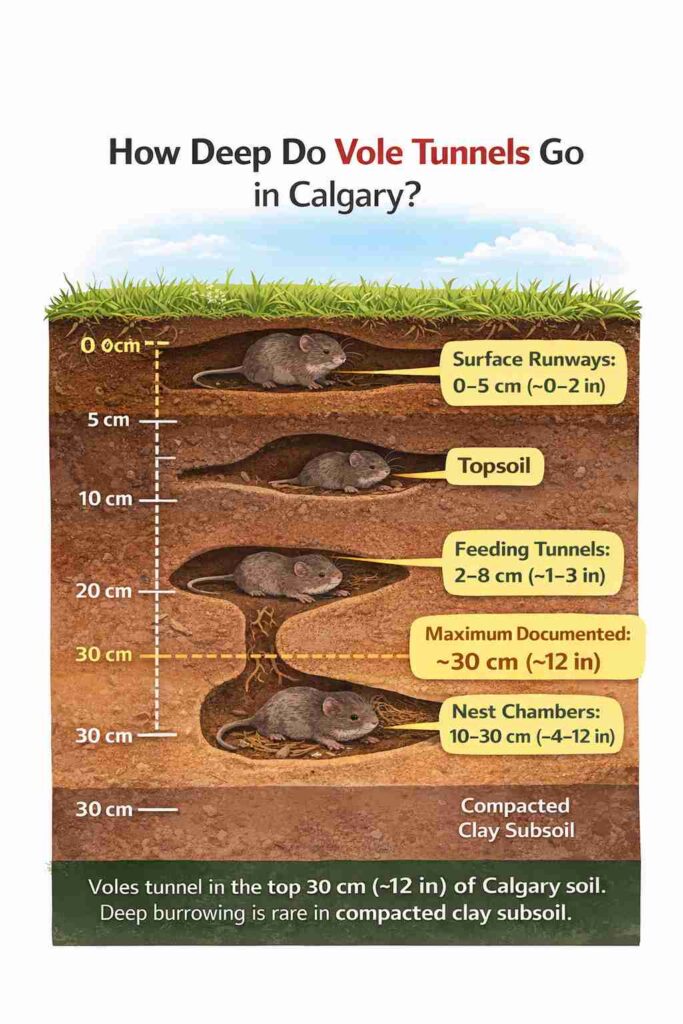
Empirical research consistently shows that vole tunnel systems are shallow by design, a finding repeatedly documented in cold‑climate vole ecology research published by university extension programs such as the University of Minnesota Extension and the University of Maine Cooperative Extension. Primary runways are typically constructed immediately below the soil surface, while nesting chambers remain confined to the upper soil profile. These characteristics are consistent across residential environments and are particularly pronounced in cold-climate regions such as Calgary.
Typical Vole Tunnel and Nest Depths in Residential Settings
| Tunnel or Nest Feature | Documented Depth Range | Observed Function |
|---|---|---|
| Surface runways | 0–5 cm | Daily movement and access to food sources |
| Feeding tunnels | 2–8 cm | Root and crown feeding beneath turf |
| Nest chambers | 10–30 cm | Breeding, shelter, and overwinter survival |
| Maximum recorded depth | ~30 cm | Rare, typically driven by soil disturbance |
Calgary’s residential soil composition further limits deep tunneling, a constraint consistent with observations reported in Canadian forestry and small‑mammal ecology research published by Natural Resources Canada and Agriculture and Agri‑Food Canada. Clay-dominant subsoils, compacted construction fill, and shallow organic layers constrain vole movement to near-surface zones where root density and oxygen availability are highest.
Comparison of Burrowing Depth by Rodent Type
| Rodent Species | Typical Burrowing Depth | Relevance to Calgary Lawns |
|---|---|---|
| Vole (Microtus spp.) | ≤ 30 cm | Common source of lawn and garden damage |
| Pocket gopher | 30–180 cm | Rare in dense urban neighborhoods |
| Ground squirrel | 60–200 cm | Localized, colony-based activity |
Winter behavior represents a distinct and well‑documented shift in vole activity, particularly in snow‑covered environments, as outlined in cold‑region vole studies from the USDA (https://www.aphis.usda.gov) and prairie‑region documentation from Alberta Agriculture and Irrigation. As soil freezes below approximately 15–25 centimeters, voles abandon soil excavation and instead establish tunnel networks within the insulated zone between snow cover and frozen ground.
Seasonal Nesting Depth Variation
| Season | Typical Nest Depth | Environmental Conditions | Documented Behavior |
|---|---|---|---|
| Summer | 5–15 cm | Warm soil, active vegetation | Shallow nests allow rapid access to grasses and roots |
| Fall | 10–20 cm | Cooling soil, pre-winter preparation | Nests deepen modestly for insulation |
| Winter | 0–5 cm (beneath snow) | Frozen soil, insulating snowpack | Nesting shifts upward into subnivean spaces |
| Spring | 5–10 cm | Thawing soil, renewed growth | Expansion of shallow tunnel networks |
Across all reviewed studies, vole tunnels were consistently documented as shallow by design. Primary runways typically occur within two to five centimeters of the soil surface, often directly beneath grass thatch or mulch. Feeding tunnels generally extend no deeper than eight centimeters, while nest chambers are most commonly found between ten and thirty centimeters below the surface. Depths approaching thirty centimeters represent the upper limit of documented vole nesting behavior rather than a routine depth.
Multiple extension services, including those from the University of Minnesota and the University of Maine, explicitly distinguish vole burrow systems from those of deeper-digging rodents. Canadian forestry studies reinforce this distinction by demonstrating that vole damage is concentrated in root zones accessible from shallow tunnels. No credible evidence supports routine vole tunneling beyond approximately thirty centimeters in residential or forest soils.
Calgary’s residential soil profile further constrains vole tunneling depth. Much of the city is characterized by clay-heavy subsoils overlain by compacted fill, particularly in newer developments where construction grading compresses underlying layers. Turf is frequently installed over substrates designed for drainage and structural stability rather than biological permeability. These conditions discourage deep burrowing and concentrate vole rodent activity close to the surface, where roots, bulbs, crowns, and tree bark are readily accessible.
Winter behavior represents a critical but often misunderstood aspect of vole tunneling. In Calgary, soil typically freezes below approximately fifteen to twenty-five centimeters during winter months. Snow accumulation insulates the surface layer, creating a subnivean zone between the frozen soil and the snowpack. Voles exploit this space to construct runways and nesting areas directly above frozen ground, allowing them to feed on grass crowns and tree bark throughout winter without penetrating deeper soil layers. Prairie vole studies and extension documentation consistently confirm that winter damage occurs at or near the surface rather than below frost depth.
Seasonal variation in nest depth follows predictable patterns driven by temperature, soil conditions, and food availability. During summer, nests typically remain between five and fifteen centimeters below the surface, allowing rapid access to grasses and roots. In fall, nests may deepen modestly to approximately ten to twenty centimeters as voles seek insulation while maintaining access to surface runways. In winter, nesting activity shifts upward into the insulated zone beneath snow, often within the top five centimeters. Spring brings renewed shallow expansion as thawing soil and vegetation growth support the establishment of new nests close to surface food sources.
These depth patterns directly explain many vole pest control failures. Treatments often fail because traps are placed too deeply, barriers are installed below the vole activity zone, or surface-only interventions are applied without intercepting established runway systems. Evidence across extension literature indicates that most vole control failures stem from misjudging tunnel depth rather than from population resistance or unusually high vole densities.
Data Summary and Comparative Context
In residential environments, surface runways typically occur at zero to five centimeters below grade, feeding tunnels at approximately two to eight centimeters, and nest chambers between ten and thirty centimeters. Maximum documented depths rarely exceed thirty centimeters. When compared to other burrowing rodents, the distinction is stark. Pocket gophers routinely excavate burrows ranging from thirty to one hundred eighty centimeters, while ground squirrels commonly reach depths between sixty and two hundred centimeters. Voles remain fundamentally surface-oriented rodents.
Expert and Community Sentiment
There is a strong consensus among extension specialists and rodent ecologists that voles are surface-root feeders and that deep soil treatments are ineffective. Experts consistently note that snow cover increases winter damage while delaying its visibility until spring melt. In contrast, homeowner perceptions frequently assume deep burrowing, leading to confusion between voles, moles, and gophers. No peer-reviewed or extension-backed evidence supports routine deep vole tunneling in Calgary soils.
Implications for Vole Control in Calgary
For residential pest control, these findings indicate that traps must intercept surface runways rather than deep soil channels. Bait placement must align with shallow feeding zones, and physical barriers should extend to approximately thirty centimeters, not deeper. Diagnostic accuracy also improves when depth is understood. Collapsing turf indicates shallow tunnel networks, while tree girdling during winter reflects snow-level feeding rather than deep root damage. Preventive strategies should prioritize reducing surface cover, disrupting runway systems, and monitoring vole activity in the fall before snowfall conceals damage.
Within Calgary’s residential environment, the shallow nature of vole tunneling has direct consequences for both diagnosis and intervention. The city’s prevalent clay-heavy subsoils, combined with compacted fill common in post-2000 housing developments, constrain vole activity to the upper soil profile. As a result, control strategies that assume deep burrowing consistently underperform in local conditions. Effective intervention depends on aligning detection and treatment with surface-level runway systems and subnivean winter activity rather than subsurface excavation.
From a diagnostic perspective, surface turf collapse, serpentine lawn runways, and springtime dieback are best interpreted as evidence of shallow feeding rather than deep soil disturbance. Winter bark damage to ornamental trees and shrubs in Calgary is likewise more accurately attributed to vole activity occurring at snow level, not below frost depth. These distinctions are critical for preventing misidentification as moles or pocket gophers, which remain uncommon in dense urban neighborhoods.
Preventive measures in Calgary are most effective when timed to late summer and early fall, before consistent snow cover establishes insulated surface corridors. Monitoring and disruption of surface cover during this period materially reduce overwinter survival and spring population expansion. Deeper structural barriers offer diminishing returns beyond approximately 30 centimeters, as vole activity rarely intersects deeper soil layers under local conditions.
Conclusion
This analysis demonstrates that vole tunneling behavior in Calgary is fundamentally shallow, surface-oriented, and strongly shaped by soil composition and seasonal climate. Across documented studies and extension literature, there is no credible evidence that vole rodents routinely tunnel beyond the upper 30 centimeters of soil in residential environments. Instead, feeding, nesting, and movement are concentrated within the root zone and, during winter, within insulated subnivean spaces above frozen ground.
Misunderstanding vole burrow depth leads directly to repeated infestations, ineffective treatments, and avoidable lawn and landscape damage, a conclusion echoed across extension guidance from Agriculture and Agri‑Food Canada and multiple U.S. land‑grant university programs. In Calgary, successful vole management depends not on deeper intervention, but on accurate alignment with the ecological realities imposed by soil structure, snow cover, and seasonal behavior.
Frequently Asked Questions (FAQ’s)
1. How deep do vole tunnels typically go in Calgary?
Documented extension and forestry research shows that vole tunnel systems are predominantly shallow. In residential Calgary soil, most vole runways occur within the top 2–5 centimetres, while nest chambers are generally found between 10 and 30 centimetres below the surface. There is no credible evidence of routine vole tunneling deeper than 30 centimetres in compacted urban or clay-heavy soils common in Calgary.
2. Do voles burrow deeper in Calgary during winter?
No. Cold-climate research indicates that voles do not burrow deeper in winter. Instead, they shift activity upward into the subnivean zone, which is the protected space between the soil surface and snow cover. In Calgary, frozen ground below approximately 15–25 centimetres restricts deeper excavation, making surface-level tunneling under snow the dominant winter behavior.
3. How does Calgary soil composition affect vole burrowing depth?
Calgary residential soil typically consists of clay-heavy subsoils, compacted fill, and construction-grade substrates. These conditions significantly limit deep tunneling. As a result, vole activity remains concentrated near surface root zones where grasses, bulbs, and tree bark are accessible. Peer-reviewed studies do not document deeper vole burrowing in compacted clay soils comparable to Calgary’s urban environment.
4. Are vole tunnels in Calgary different from tunnels in agricultural or forested areas?
Yes, but only in density and layout—not depth. In agricultural and forestry environments, vole tunnel networks may spread laterally over larger areas due to looser soils and uninterrupted vegetation. However, depth remains shallow across environments, with feeding and nesting still concentrated within the upper soil layers. Calgary’s urban compaction further constrains depth rather than increasing it.
5. Why is vole damage in Calgary often invisible until spring?
Vole tunnels and feeding activity occur below turf and snow cover, making damage difficult to detect during winter. In Calgary, extended snow cover conceals runway systems while voles feed continuously on grass crowns and tree bark. Damage becomes visible only after snowmelt, when turf collapse and girdling are already advanced.
6. Do voles ever create deep burrows like gophers or ground squirrels?
No. Voles are biologically and behaviorally distinct from deep-burrowing rodents. Research consistently shows that voles are surface-root feeders and do not create deep, structural burrow systems. Mistaking vole damage for gopher or ground squirrel activity is a common diagnostic error in Calgary residential settings.