White Paper: The Real Cost of Ignoring Vole Damage in Calgary
Abstract
Vole infestations represent a consistently underestimated source of financial and structural loss across Calgary. While vole activity is often dismissed as cosmetic or seasonal, documented evidence from cold-climate regions demonstrates that delayed or ignored vole damage results in disproportionately high remediation costs. This paper examines the real, documented economic consequences of ignoring vole damage in residential, commercial, acreage, and landscaped municipal contexts, and compares those losses against the cost of proactive vole control. The findings show that early intervention is not only biologically effective but economically rational within Calgary’s environmental and urban conditions.
Research Question
What are the real, documented financial and structural costs of ignoring vole damage in Calgary, and how do these costs compare with the cost of proactive vole control?
Why This Matters in Calgary
Calgary’s environmental and land-use conditions create an unusually favourable environment for vole survival and damage amplification. Extended winter snow cover insulates the ground surface, allowing voles to feed continuously on turf and woody plants without visual detection. The city’s extensive greenbelts, irrigation corridors, parks, and pathway systems provide uninterrupted habitat connectivity into residential and commercial landscapes. New residential developments frequently disrupt predator populations while simultaneously introducing sod, ornamental trees, and shelterbelts that serve as ideal vole food sources.
As a result, vole damage in Calgary is commonly misdiagnosed as winter kill, drought stress, or poor soil conditions. This misattribution delays treatment until turf loss, tree girdling, or soil destabilisation has progressed beyond recovery. At that stage, replacement becomes unavoidable, and costs escalate sharply.
Scope and Methodology
This paper focuses on the City of Calgary and surrounding communities, including Airdrie, Okotoks, Cochrane, and Chestermere, with supporting evidence drawn from Southern Alberta agricultural zones where vole behavior and impacts are comparable. The temporal scope spans documented research and extension data from 1990 through 2025.
The analysis synthesizes documented vole damage costs, seasonal feeding behavior, soil and landscape influences, and economic outcomes associated with delayed response. Sources include Natural Resources Canada, Alberta Agriculture and Forestry publications, Canadian and U.S. university extension research, peer-reviewed orchard, forestry, and forage studies, and documented grower and landowner surveys.
Speculative estimates, non-vole rodent damage, and unsupported marketing claims were intentionally excluded to preserve analytical integrity.
Calgary-Specific Conditions That Amplify Vole Damage
Voles are native to Alberta and highly adapted to prairie and parkland ecosystems. Calgary’s conditions do not suppress vole populations; rather, they intensify damage outcomes. Persistent snow cover acts as a thermal blanket that protects voles from predators and extreme cold while enabling uninterrupted winter feeding. Urban and suburban edge habitats create stable population reservoirs adjacent to managed landscapes. Predator effectiveness is reduced in dense urban zones, and irrigated lawns remain attractive food sources even during dry summers.
Certain Calgary property types consistently experience higher damage severity. These include new housing developments, acreages and hobby farms, properties bordering parks or wetlands, and landscaped commercial sites that rely on mulch and ground cover.
Historical and Regional Evidence of Economic Impact
While Calgary-specific cost studies are limited, extensive North American and Canadian research applies directly due to shared vole species and cold-climate conditions. Orchard studies under heavy vole pressure document yield losses ranging from 36 to 66 percent, equating to annual losses exceeding several thousand dollars per acre. Ontario orchard producers have repeatedly identified vole damage as more economically severe than insect pressure during outbreak years.
Forestry studies across Western Canada report seedling mortality ranging from 15 percent to complete stand loss under vole pressure. Forage producers in cold-climate regions report average crop losses of approximately 28 percent during vole population surges. These findings consistently demonstrate that cold winters do not suppress vole populations and often increase damage severity by concealing activity until spring.
Lawn and Turf Damage Escalation in Calgary
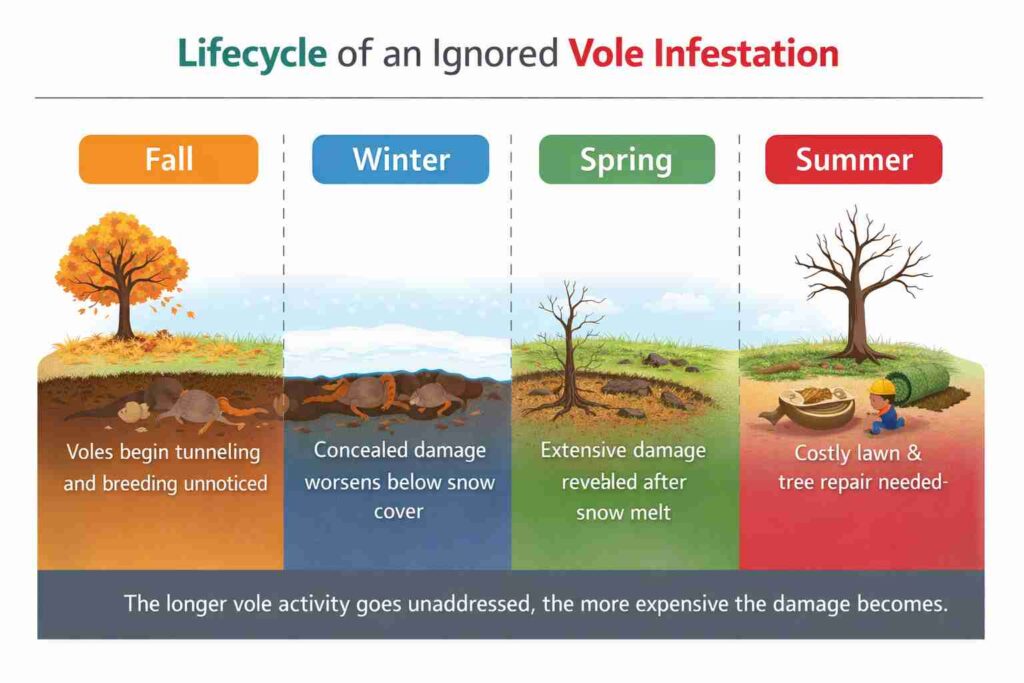
In Calgary, vole damage to lawns typically becomes visible only after snowmelt. By this stage, surface runways, dead turf patches, collapsed sod, and soil instability are already widespread. The financial impact escalates rapidly once turf loss exceeds spot repair.
Typical Lawn Restoration Costs in Calgary
| Damage Outcome | Estimated Cost Range |
|---|---|
| Localised sod replacement | $3–$6 per square foot |
| Partial lawn restoration | $1,500–$3,500 |
| Full lawn replacement | $3,000–$8,000+ |
Ignoring vole activity converts a manageable pest issue into a full landscaping rebuild. Repeat damage is common when voles are not treated before re-sodding.
Tree and Shrub Losses Are Often Irreversible
Voles frequently girdle tree trunks and root flares beneath snow cover, particularly affecting ornamental and fruit trees common in Calgary landscapes. Once bark removal encircles the trunk, vascular damage is irreversible. Affected trees typically decline and die within a single growing season, regardless of subsequent treatment.
Replacement costs vary widely based on tree size and species, but commonly range from several hundred dollars for young ornamentals to several thousand dollars for mature trees. At this stage, pest control no longer mitigates loss; only replacement remains viable.
Acreages and Small Farms Face Compounding Losses
Acreages and small farms in Southern Alberta experience cumulative vole damage that extends beyond a single season. Pasture degradation, forage loss, fence-line erosion, and long-term soil disturbance are common outcomes. Research indicates that vole densities as low as one hundred individuals per acre can destroy approximately four percent of forage, while severe infestations routinely exceed twenty-five percent yield loss.
These losses compound annually when vole populations are not controlled, transforming what might appear to be minor surface damage into multi-season financial exposure.
Winter Concealment as a Cost Multiplier
Calgary’s winter conditions enable voles to feed, reproduce, and expand tunnel networks without detection. Property owners typically discover damage in spring, when lawns fail to green and trees exhibit stress or mortality. By this stage, intervention costs are significantly higher and recovery options are limited.
Delayed detection consistently emerges as the single greatest factor driving cost escalation.
Cost Comparison: Proactive Control Versus Ignoring Damage
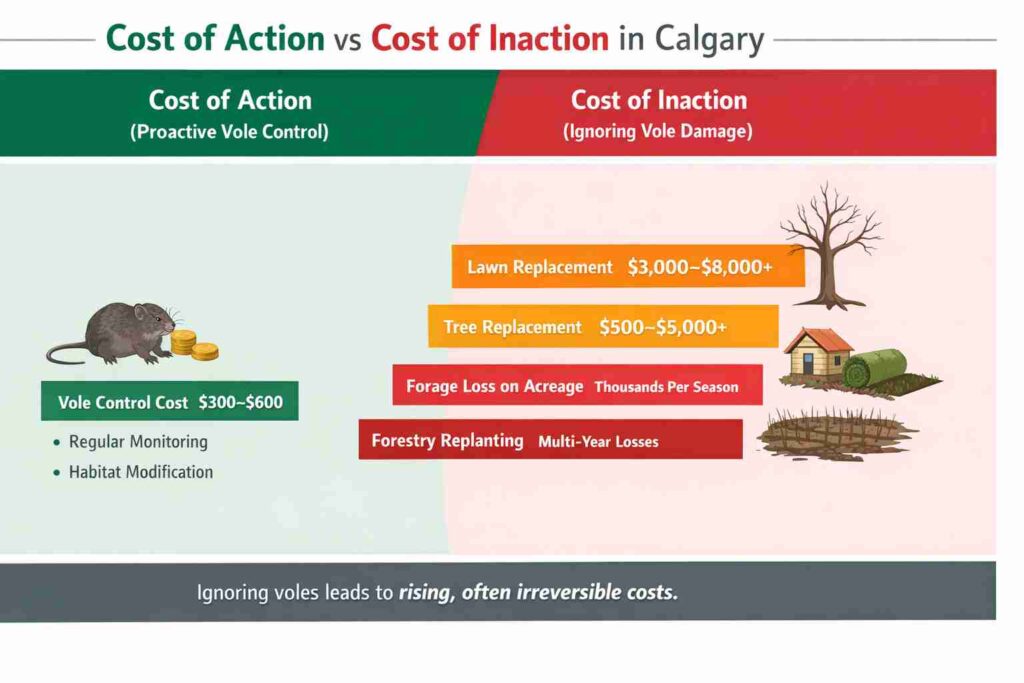
Relative Cost Comparison in Calgary
| Scenario | Financial Impact |
|---|---|
| Proactive vole control | Low and predictable |
| Full lawn replacement | $3,000–$8,000 |
| Mature tree replacement | $500–$5,000+ per tree |
| Acreage forage loss | Thousands per season |
| Forestry replanting | Multi-year capital loss |
Expert and Industry Consensus
Extension agencies and agricultural researchers consistently identify voles as among the most destructive small mammals in cold-climate urban environments. The prevailing consensus is that early intervention is the only cost-effective strategy. While some property owners tolerate low levels of vole activity, damage thresholds are routinely underestimated until structural or ecological collapse occurs.
In Calgary, this challenge is intensified by the frequent misdiagnosis of vole damage as winter kill or drought stress.
Implications for Calgary Property Owners
For homeowners, ignoring vole activity leads to lawn collapse and tree loss. Commercial properties face operational disruption and budget overruns due to landscape replacement. Acreage owners experience compounding forage and soil losses. Municipal spaces incur repeated turf replacement that strains maintenance budgets.
In Calgary, vole control functions as a preventive asset-protection measure rather than a reactive service.
Conclusion
In Calgary, the financial cost of ignoring vole damage consistently exceeds the cost of proactive vole control. Cold winters, prolonged snow cover, and urban landscaping conditions allow voles to cause extensive, hidden damage that is often irreversible by the time it is discovered. Early treatment and ongoing vole control remain the only strategies proven to reduce long-term financial exposure under Calgary conditions.
Early vole control in Calgary is not optional maintenance—it is a defensible financial risk-reduction strategy.
Frequently Asked Questions (FAQ’s)
1. How much does vole damage typically cost homeowners in Calgary?
Documented landscaping data and contractor pricing indicate that vole damage repair in Calgary commonly ranges from $3,000 to $8,000 for full lawn restoration, depending on yard size and severity. Tree replacement costs can exceed $5,000 per mature ornamental tree once girdling occurs. These figures exclude repeat damage when voles remain untreated.
2. Why is vole damage often mistaken for winter kill in Calgary?
Vole feeding occurs beneath snow cover, leaving damage invisible until spring melt. Turf collapse, dead patches, and exposed roots closely resemble winter kill or drought stress. Extension services consistently report that this misdiagnosis delays treatment, allowing vole populations to expand undetected.
3. Do cold Calgary winters reduce vole populations naturally?
No documented research supports this assumption. Cold-climate studies show that snow acts as insulation, enabling voles to feed continuously through winter. In many cases, winter conditions increase damage severity by concealing activity rather than suppressing populations.
4. Are voles only a problem for lawns, or do they damage trees as well?
Voles cause significant damage to tree trunks, roots, and bark, particularly apple, crabapple, poplar, spruce, and shelterbelt species common in Calgary landscapes. Once girdling occurs, the tree typically dies within one growing season, making replacement unavoidable.
5. Is proactive vole control actually cheaper than waiting?
Yes. Extension and agricultural research consistently demonstrate that early vole control costs are predictable and significantly lower than restoration costs. Waiting shifts expenses from manageable treatment to high-cost replacement of turf, trees, and forage.
6. Why does vole damage keep returning after lawn repair?
Lawn repair alone does not address the underlying vole population. Without proper vole rodent control and habitat disruption, repaired areas remain attractive food sources, leading to repeated damage within one or two seasons.